







Texas Pipeline Damage Prevention Statistics

Pipeline Safety ANNOUNCEMENTS
NOTICE TO ALL RRC REGULATED OPERATORS
Increased Possibility of Cyber AttacksApril 10, 2026
The Environmental Protection Agency (EPA) and the Cybersecurity and Infrastructure Security Agency (CISA) issued new advisories this week warning of an increased possibility of cyber attacks.
These attacks are targeting internet-facing operational technology (OT) devices, including programmable logic controllers (PLCs) across US critical infrastructure potentially causing operational disruption and financial loss.
Some organizations in critical infrastructure sectors have already experienced disruptions caused by malicious interactions with the project files and the manipulation of data displayed on human machine interface (HMI) and supervisory control and data acquisition (SCADA) displays.
Recommended Actions from CISA
Operators should take the following steps to strengthen cyber resilience:
- Remove PLCs from direct internet exposure via secure gateway and firewall.
- Query available logs for the provided IOCs in the corresponding time frames.
- Check available logs for suspicious traffic on the ports associated with OT devices, including 44818, 2222, 102, and 502, especially traffic originating from overseas hosting providers.
- For Rockwell Automation devices
- Place the physical mode switch on the controller into run position.
- Contact the authoring agencies and Rockwell Automation for guidance if you believe your organization was targeted.
Additional Resources:
- EPA advisory: https://www.epa.gov/newsreleases/epa-fbi-cisa-nsa-issue-joint-cybersecurity-advisory-water-system-regarding-iranian
- CISA advisory: https://www.cisa.gov/news-events/cybersecurity-advisories/aa26-097a?utm_source=IranPLC202604&utm_medium=GovDelivery
The RRC maintains a 24-hour, toll-free emergency line, 844-773-0305, to report emergencies, including leaks or spills and damage to gas pipelines.
To view the full notice, visit the RRC website at https://www.rrc.texas.gov/media/3o3prooh/4102026-notice-to-operators-increased-possibility-of-cyber-attacks.pdf
Overview
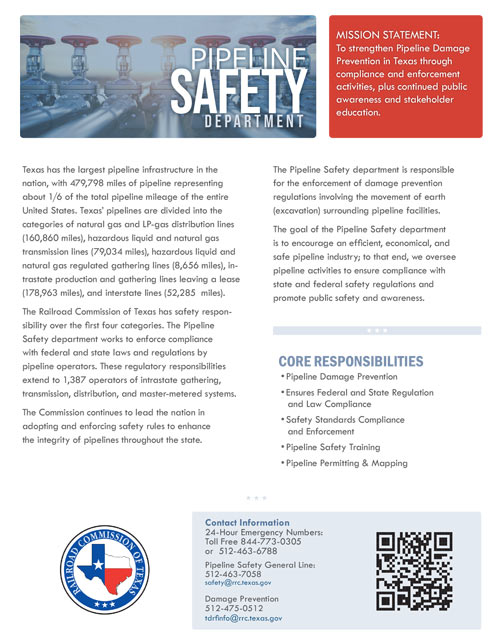
Printable Overview
What we do
The Oversight and Safety Division has responsibility for Alternative Fuels, Gas Services and Pipeline Safety. This reorganization in January 2015 will bring even greater efficiency and consistency to these operations within the Railroad Commission of Texas (RRC), allowing the agency to better serve the state.
Texas has the largest pipeline infrastructure in the nation, representing about 1/6 of the total pipeline mileage of the entire United States. Texas’ pipelines are divided into the categories of natural gas and LP-gas distribution lines, hazardous liquid and natural gas transmission lines, hazardous liquid and natural gas regulated gathering lines, intrastate production and gathering lines leaving a lease, and interstate lines. The RRC has safety responsibility over the first four categories.
Pipelines that cross between states are considered Interstate and would be under the jurisdiction of the U.S. Dept. of Transportation (DOT) - Pipeline and Hazardous Materials Safety Administration (PHMSA). The PHMSA southwest regional office located in Houston covers Arkansas, Louisiana, New Mexico, Oklahoma, and Texas.
The Pipeline Safety department works to enforce compliance with federal and state laws and regulations by pipeline operators. These regulatory responsibilities extend to operators of intrastate gathering, transmission, distribution, and master-metered systems. The RRC continues to lead the nation in adopting and enforcing safety rules to enhance the integrity of pipelines throughout the state.
Pipeline Safety rules administered by the RRC are adopted in the Texas Administrative Code, containing State specific requirements and incorporates by reference the minimum Federal safety standards for transportation of gas and hazardous liquids by pipeline and liquefied natural gas facilities.
The RRC also promotes and enforces an underground pipeline damage prevention program for Texas. The Pipeline Safety department is responsible for the enforcement of damage prevention regulations involving the movement of earth (excavation) surrounding pipeline facilities.
The goal of the Pipeline Safety department is to encourage an efficient, economical, and safe pipeline industry; to that end, we oversee pipeline activities to ensure compliance with state and federal safety regulations and promote public safety and awareness.
Commissioners
-
 Jim Wright
Chairman -
 Christi Craddick
Commissioner -
 Wayne Christian
Commissioner
Audiences