








Contact Information
- Critical Infrastructure Phone: 512-463-6737
- General Email: CID@rrc.texas.gov
- CID Regions by County
- CID Regional Office Information
Critical Infrastructure ANNOUNCEMENTS
NOTICE TO ALL RRC REGULATED OPERATORS
Increased Possibility of Cyber AttacksApril 10, 2026
The Environmental Protection Agency (EPA) and the Cybersecurity and Infrastructure Security Agency (CISA) issued new advisories this week warning of an increased possibility of cyber attacks.
These attacks are targeting internet-facing operational technology (OT) devices, including programmable logic controllers (PLCs) across US critical infrastructure potentially causing operational disruption and financial loss.
Some organizations in critical infrastructure sectors have already experienced disruptions caused by malicious interactions with the project files and the manipulation of data displayed on human machine interface (HMI) and supervisory control and data acquisition (SCADA) displays.
Recommended Actions from CISA
Operators should take the following steps to strengthen cyber resilience:
- Remove PLCs from direct internet exposure via secure gateway and firewall.
- Query available logs for the provided IOCs in the corresponding time frames.
- Check available logs for suspicious traffic on the ports associated with OT devices, including 44818, 2222, 102, and 502, especially traffic originating from overseas hosting providers.
- For Rockwell Automation devices
- Place the physical mode switch on the controller into run position.
- Contact the authoring agencies and Rockwell Automation for guidance if you believe your organization was targeted.
Additional Resources:
- EPA advisory: https://www.epa.gov/newsreleases/epa-fbi-cisa-nsa-issue-joint-cybersecurity-advisory-water-system-regarding-iranian
- CISA advisory: https://www.cisa.gov/news-events/cybersecurity-advisories/aa26-097a?utm_source=IranPLC202604&utm_medium=GovDelivery
The RRC maintains a 24-hour, toll-free emergency line, 844-773-0305, to report emergencies, including leaks or spills and damage to gas pipelines.
To view the full notice, visit the RRC website at https://www.rrc.texas.gov/media/3o3prooh/4102026-notice-to-operators-increased-possibility-of-cyber-attacks.pdf
Overview
Printable Overview
What we do
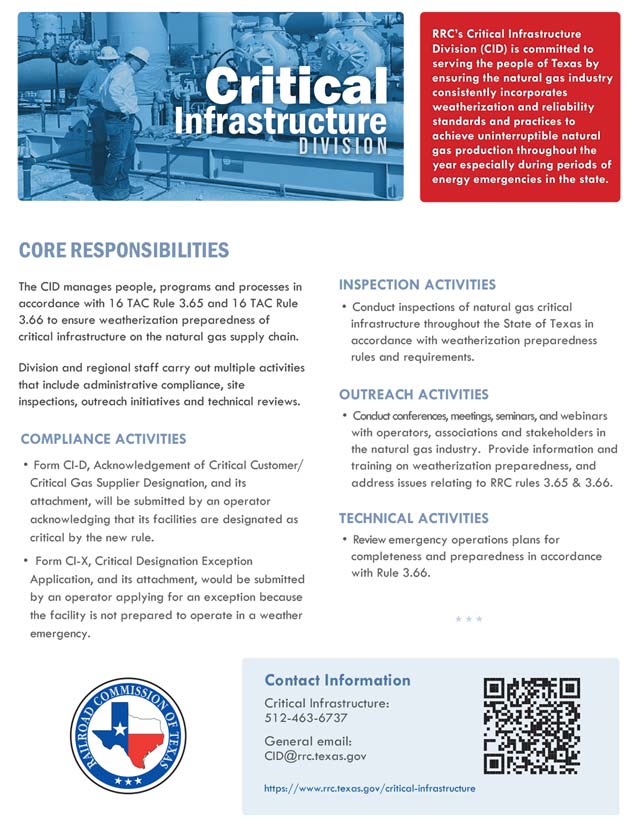
RRC’s Critical Infrastructure Division (CID) is committed to serving the people of Texas by ensuring the natural gas industry consistently incorporates weatherization and reliability standards and practices to achieve uninterruptible natural gas production throughout the calendar year including periods of severe weather.
The CID will vigilantly oversee and manage adherence to weatherization rules, adopted by the RRC, including ensuring companies within the natural gas supply chain register their assets as Critical Infrastructure.
On November 30, 2021 The Railroad Commission of Texas commissioners adopted rules for critical designation of natural gas infrastructure to help protect Texans in energy emergencies. The new rules implement provisions in House Bill 3648 and Senate Bill 3 and define natural gas facilities that would be designated as critical gas suppliers and critical customers.
Critical gas suppliers include, but are not limited to, gas wells, oil leases that produce gas, natural gas pipeline facilities, underground natural gas storage facilities and saltwater disposal facilities.
Critical customers, which are a subset of critical gas suppliers, are facilities that require electricity to operate. These operators will submit a critical customer information to their electric utilities so that their electric utilities have the correct information for purposes of supplying power to the facilities.
Senate Bill 3 includes language to allow for certain facilities to apply for an exception to critical designation. However, the newly adopted rules exclude certain types of highly critical facilities from being able to apply for an exception. Examples include any facility that will be on the state’s electricity supply chain map, which is due to be published next year, underground gas storage facilities, pipelines that directly serve a power generation plant or local gas distribution companies, gas wells and oil leases that produce a large amount of gas per day, and gas processing plants. Applications for exception require objective evidence proving reasonable cause and justification, which will be reviewed, and RRC staff can deny an application.
Commissioners
-
 Jim Wright
Chairman -
 Christi Craddick
Commissioner -
 Wayne Christian
Commissioner
Audiences